News & Insights
2026年2月2日
QC vs QA: The Critical Difference That Can Save Your Business
QC vs QA: What's the real difference? QA prevents defects with processes; QC detects them through inspections. Simple guide to build a better supply chain in 2026.
QC vs QA: Why Most Importers Mix Them Up – And Why It Costs Money
In importing, people throw around "QC" and "QA" like they're the same thing. They're not.
Quality Assurance (QA) is proactive – it builds systems to prevent defects.
Quality Control (QC) is reactive – it inspects products to find defects.
Understanding this difference isn't theory. It's practical strategy. Get it wrong, and you waste money on rework or returns. Get it right, and you build a reliable supply chain.
The Simple Analogy: Running a Restaurant (Tomato Soup Example)
Imagine you're running a restaurant famous for tomato soup.
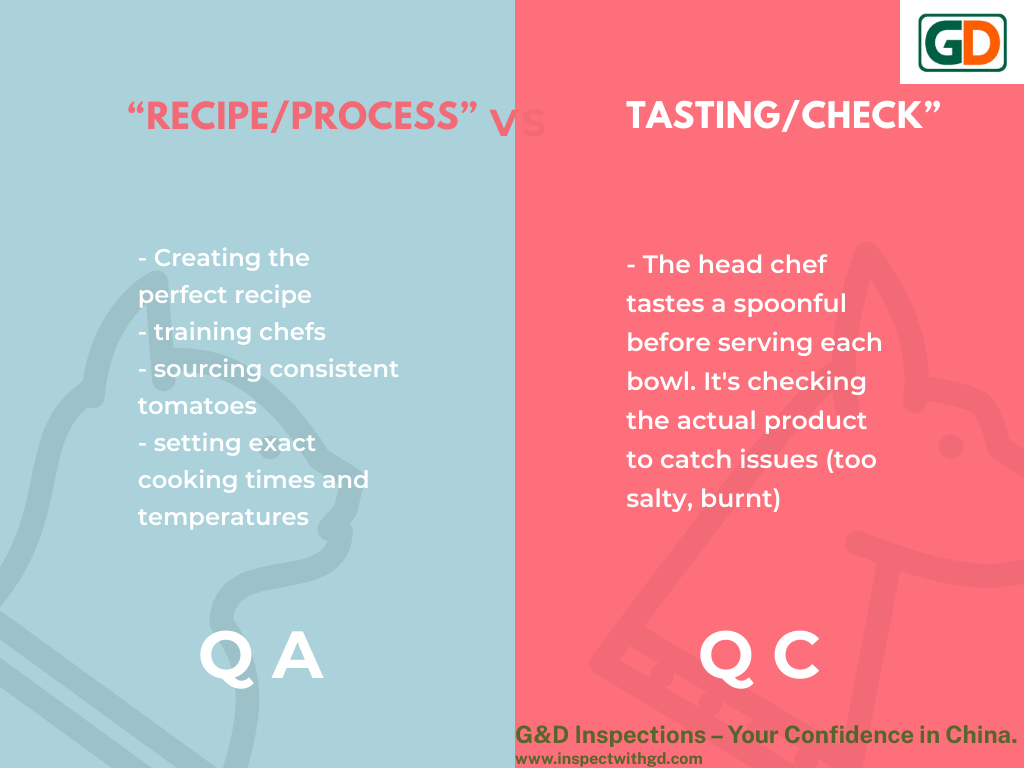
- Quality Assurance (QA): Creating the perfect recipe, training chefs, sourcing consistent tomatoes, setting exact cooking times and temperatures. It's about designing a process so bad soup never gets made. QA is proactive and process-focused – preventing problems before they happen.
- Quality Control (QC): The head chef tastes a spoonful before serving each bowl. It's checking the actual product to catch issues (too salty, burnt) and fix them. QC is reactive and product-focused – finding and correcting defects after production.
You can have a great recipe (strong QA), but if the chef skips steps, you need tasting (QC). You can taste every bowl (heavy QC), but if the recipe is bad (weak QA), you'll fix issues all day.
You need both to succeed consistently.
QC vs QA: Side-by-Side Comparison Table
Aspect | Quality Assurance (QA) | Quality Control (QC) |
|---|---|---|
Focus | Process – Is the system designed to make good products? | Product – Did the system actually make good products? |
Timing | Before & during production | After production (or at key checkpoints) |
Goal | Prevent defects | Detect & correct defects |
Responsibility | Factory management & entire team | Specific inspectors (often third-party) |
Examples in Importing | Factory audits, process documentation, supplier training | On-site inspections (IPC, DUPRO, FRI), lab testing, final checks |
Outcome | Consistent quality over time | Immediate fixes or rejection of bad batches |
Real-World Example: Why We Started Inspect with GD
We built our company from frustrations we saw firsthand.
Gaby spent years in trading companies. She saw factories with impressive QA certificates and systems on the wall – but products still full of defects. Their process looked good on paper, but execution failed. Generic checklists missed critical issues because inspectors lacked product expertise.
Dacy saw the flip side in buying offices: "perfect" QC reports from samples, but the factory's QA system couldn't maintain quality across 10,000 units. They made great samples for inspection, but the overall process was weak.
We realized importers need both: a supplier with solid QA (assessed via Factory Audit), and independent, expert QC (like our FRI inspections) to verify reality.
In 2026, with supply chains faster and more complex, this gap still costs businesses thousands – but understanding QA vs QC helps close it.
The Bottom Line: You Need Both – But Prioritize Wisely
- QA is mostly the factory's job – build quality in from the start. Assess it with a Factory Audit before ordering.
- QC is your job (or your trusted partner's) – verify the product meets specs. Services like Final Random Inspection (FRI) are your ultimate QC tool.
Don't assume a factory with strong QA doesn't need QC. And don't rely on QC alone to fix a broken QA process.
By getting QA right (prevention) and layering QC (detection), you protect your business, reduce returns, and build long-term reliability.
Still Confused About Your Supply Chain?
Every product and supplier is different.
Tell us your situation – product type, order size, current worries – and we'll help you balance QA & QC the smart way.
[Get Free Advice on QA & QC Strategy]
[Contact Us via WhatsApp/Email]
FAQ: Quick Answers on QC vs QA
Is QC part of QA?
Yes – QC is a subset of QA. QA covers the full system; QC is the inspection/check part.
Who handles QA vs QC in importing?
QA: Factory & supplier. QC: Importer + third-party (like us) for independence.
Do I need both in 2026?
Absolutely – prevention (QA) + detection (QC) is still the best defense against defects and delays.
How do I check a supplier's QA?
Start with a Factory Audit – it reviews their processes, not just products.