
News & Insights
2026年2月3日
Final Random Inspection (FRI) Guide: Your Step-by-Step Process to Avoid Defects
What is Final Random Inspection (FRI)? Simple 2026 guide for importers: steps, AQL sampling, checklist & tips to avoid defects from China. Save budgets & build trust – free template included.
Why Final Random Inspection (FRI) is Critical for Importers in 2026
Final Random Inspection (FRI) is your last quality checkpoint before payment and shipment – a random sample check of finished, packed goods to verify they meet specs, workmanship, and packaging standards.
In short: Done when 100% produced and at least 80% packed, using AQL sampling to spot defects efficiently.
With 2026 supply chains faster, FRI prevents costly returns or recalls. It catches visible defects like workmanship flaws or packaging issues that could lead to customer complaints.
The 5 Key Reasons to Do a Final Random Inspection
- Catch Defects Early (Save Budget): Spots major/minor/critical issues before shipment. Saves 10x on rework – crucial for small budgets.
- Ensure Product Consistency: Verifies finished goods match approved samples – e.g., color uniformity or assembly quality.
- Build Trust with Suppliers: Independent FRI shows seriousness, improving future performance.
- Protect Brand Reputation: Stops bad products reaching customers – vital with logistics delays.
- Support Letters of Credit: Many banks require FRI reports for payment.
From our experience with hundreds of shipments, skipping FRI often costs more in returns than the inspection fee.
Step-by-Step: The Final Random Inspection Process
Based on ISO 2859-1 / ANSI Z1.4 standards (stable in 2026).
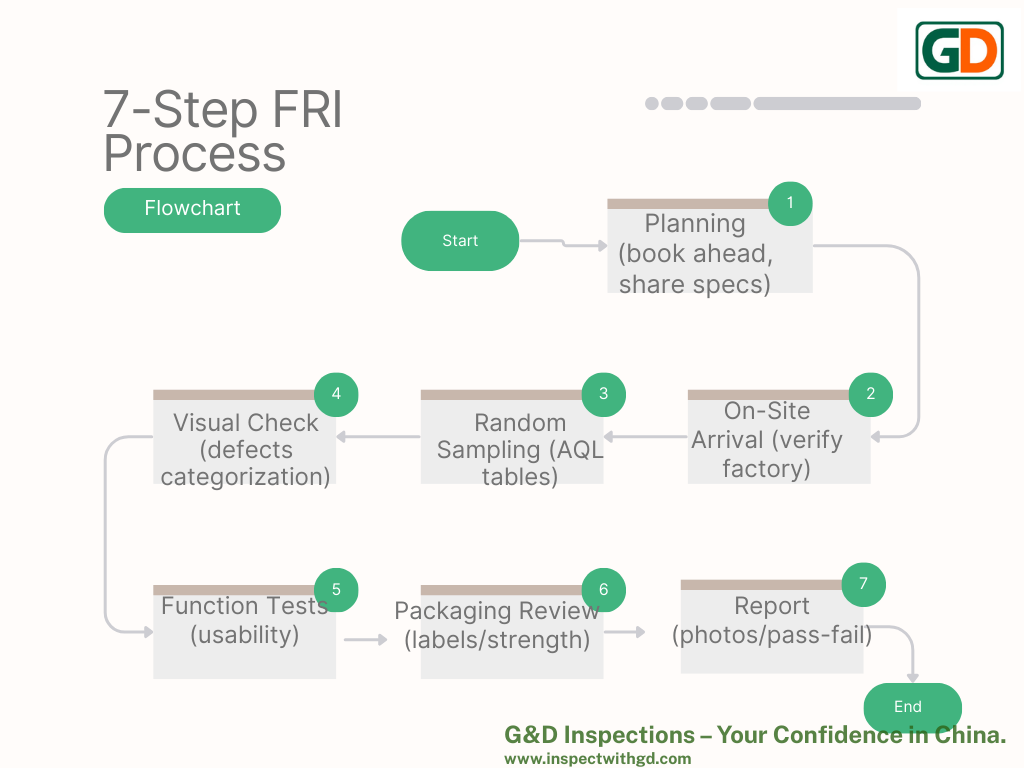
- Planning: Book 1–2 weeks ahead. Share specs, AQL levels (e.g., 0.0 critical, 2.5 major, 4.0 minor), checklist.
- On-Site Arrival: Inspector verifies factory, counts produced/packed quantities.
- Random Sampling: Use AQL tables – e.g., 4000 pieces (Level II) → sample 200.
- Visual & Workmanship Check: Categorize defects (minor stain vs major tear).
- Function & Safety Tests: Basic usability checks (e.g., button functionality, seam strength).
- Packaging & Labeling: Ensure boxes sturdy, labels clear and consistent.
- Report Generation: Photos, data, pass/fail in <24h.
Focus on corrective actions if fail.
Final Random Inspection Checklist (Free Download Template)
Category | Items to Check | Example |
|---|---|---|
Quantity | Produced vs ordered | 1000 units vs 1000 |
Visual | Defects (minor/major/critical) | Stains, scratches |
Function | Usability | Button works, fit correct |
Safety | Basic checks | No sharp edges |
Packaging | Strength, labels | Boxes sealed, instructions included |
Docs | Attached certificates | Labels match specs |
Download our free FRI checklist (email form) – customized for your products.
Common Mistakes to Avoid in FRI
- Skipping sampling (bias risk)
- Ignoring minor defects (they add up)
- No buffer time (2 weeks for rework)
- Unqualified inspector (lacks product knowledge)
For budget-conscious clients, FRI is 80% effective alone.
How to Choose a FRI Partner (Build Trust)
- Industry expertise (10+ years)
- Transparent pricing ($160+/man-day)
- Fast reports (<24h, photos)
- Independent verification
We specialize in small orders, addressing trust issues with detailed, photo-heavy reports.
FAQ: Quick Answers on FRI in 2026
What's FRI vs during production?
FRI is final check; during catches mid-process issues.
How much does FRI cost?
Starting at $160/man-day – saves more in defects.
Is FRI mandatory?
Not always, but highly recommended for most shipments.
Ready to safeguard your shipment? Get our free FRI plan – message for details.
[Button: Free FRI Checklist Download]
[Button: Contact for Consultation]